
By Chance, owner of Southern Gutters FL · Published · Last updated
Key takeaways
- Mid-century block homes often lack gutters entirely, so water splashes off the slab edge and stains the stucco.
- Check the fascia and the roof edge before adding gutters; original wood fascia is often soft or missing.
- Florida rooms and flat-roof carports usually need their own drainage plan, separate from the main roof.
- Downspouts on slab homes should discharge well away from the foundation and out of narrow side yards.
- Painted seamless aluminum in a color that matches the trim suits the clean lines of mid-century houses.
Most mid-century CBS homes benefit from gutters on at least the sides where roof water lands on doors, walkways, patios or narrow side yards. Before adding them, the fascia and roof edge must be sound, Florida rooms and carports need their own drainage plan, and every downspout should carry water away from the slab.
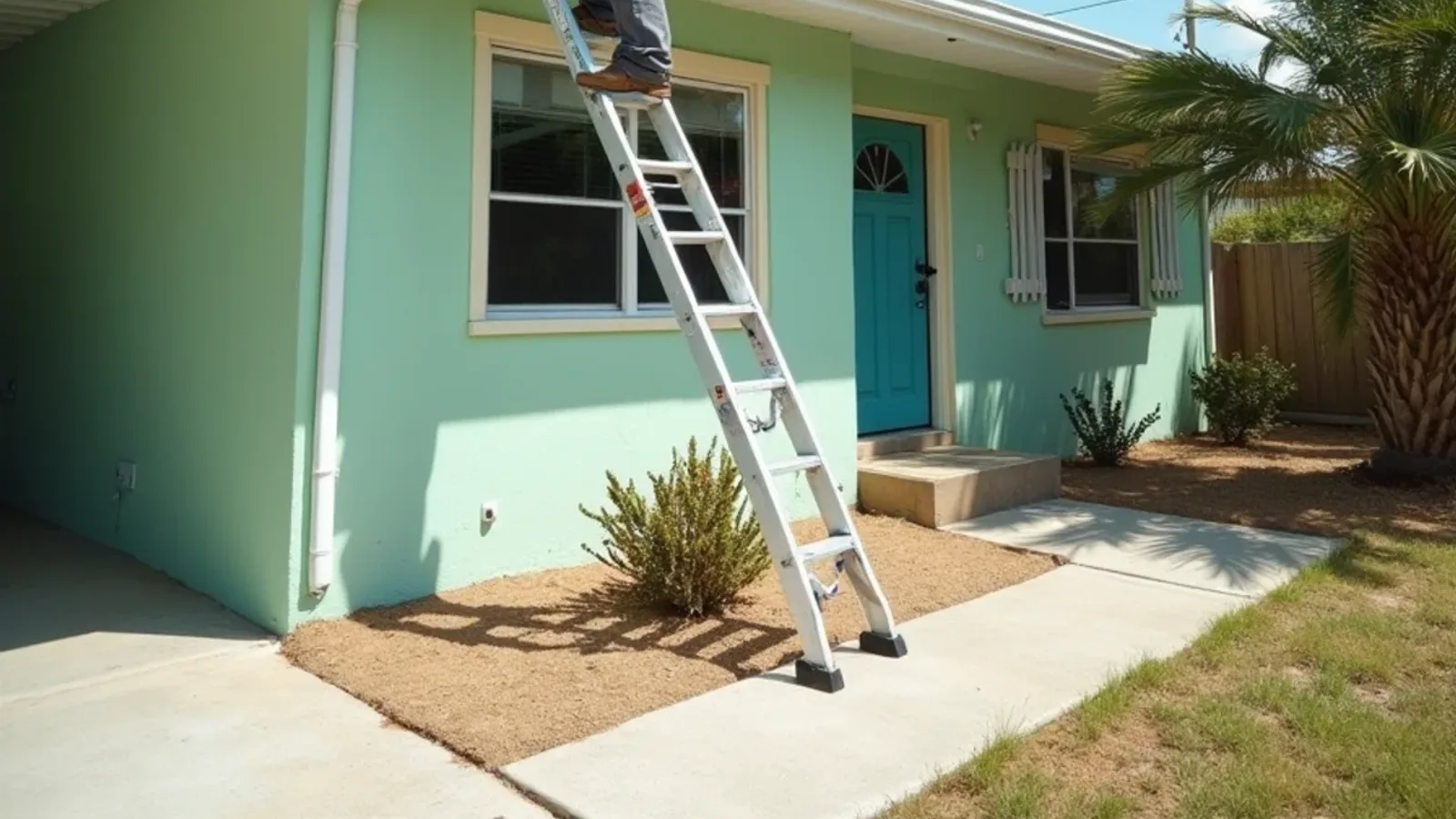
Drive through the postwar neighborhoods of Fort Lauderdale or Hollywood and you will see street after street of concrete block and stucco ranch houses with low hip roofs, jalousie or awning windows and no gutters at all. Builders of that era often skipped them. The thinking was that a wide overhang and a sandy yard would handle the rain.
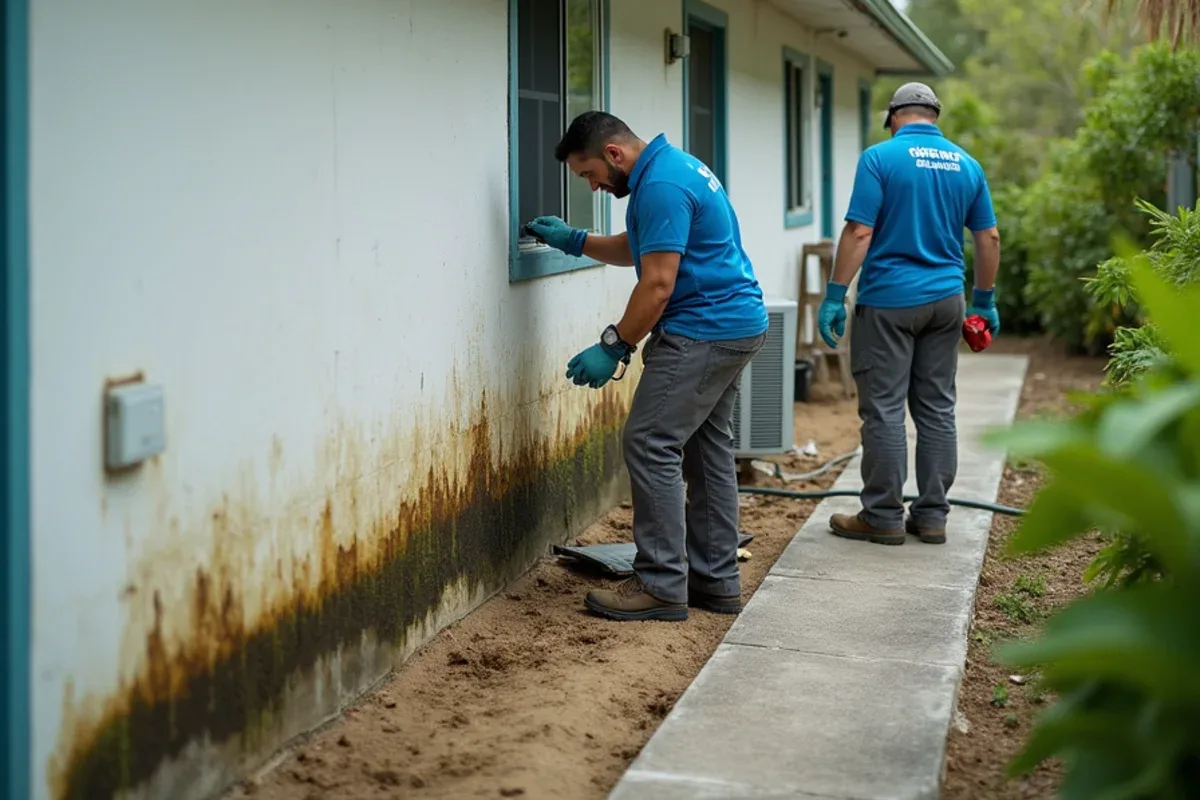
Decades later, many owners see the results: stucco stained in a stripe along the bottom of every wall, splash-back mildew, a washed-out drip line, and water pooling at the edge of the slab. Gutters for CBS homes solve those problems, but these houses have quirks that newer construction does not. This guide walks around a typical block ranch and covers what we look at on each side.
Why so many mid-century CBS homes have no gutters
CBS stands for concrete block and stucco, the standard way South Florida houses were built from the postwar boom onward. Block walls do not rot, so builders saw less reason to protect them from roof runoff, and gutters were treated as optional. Roofs were mostly low-pitch hips or gables with asphalt shingle, sometimes with a flat-roof carport or porch tacked on.
The walls survive the water just fine. What suffers is everything around them. Rain falling from the eave hits the ground right at the wall, splashes dirt onto the stucco, soaks the bottom course of block, and digs a trench that eventually reaches the slab edge. Inside, owners sometimes notice musty corners or damp baseboards on the side that takes the most runoff.
Adding gutters to an old house: what to check first
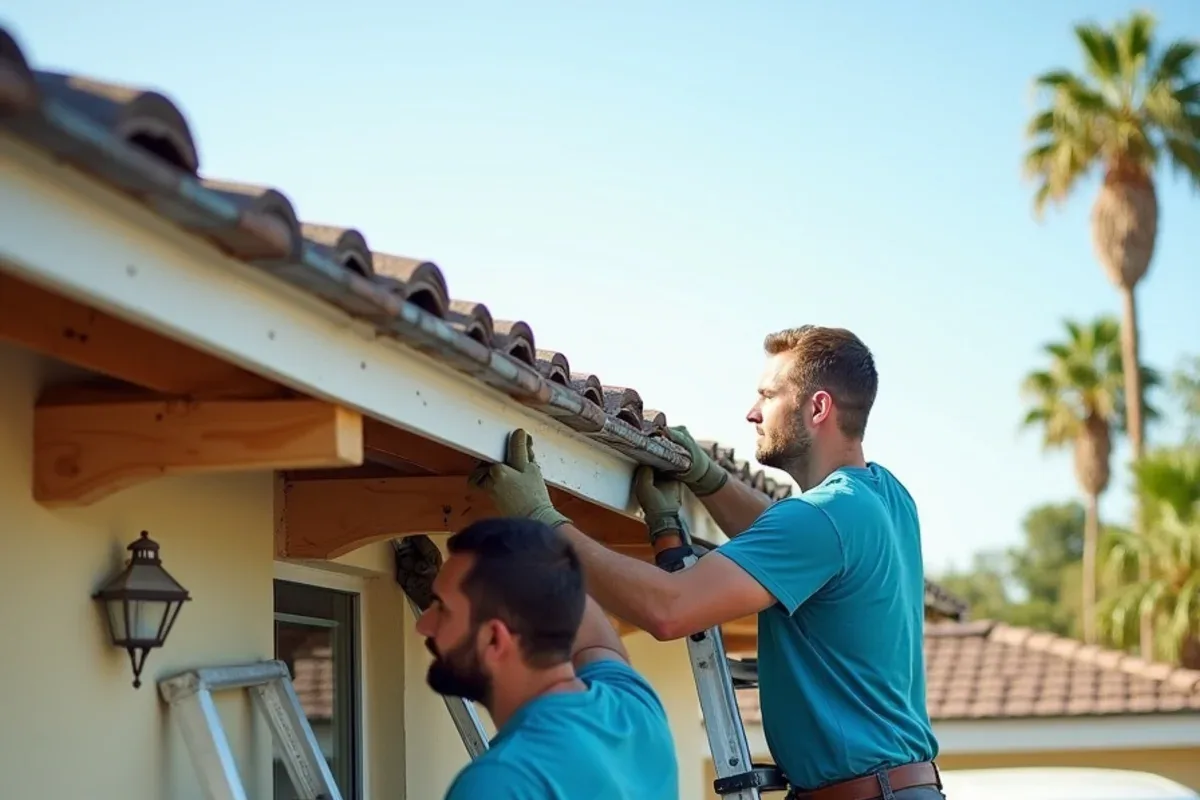
Before any gutter goes up, the roof edge has to be able to hold it. On homes of this age we check four things.
- Fascia condition. Original fascia is often decades-old wood. We probe it along the full length; soft sections get replaced before hanging anything.
- Exposed rafter tails. Some mid-century houses have open rafter ends with no continuous fascia board. Those need a new fascia or a hanger system that fastens to the roof deck.
- Drip edge. Without metal drip edge at the shingle line, water can wick behind a new gutter. Adding it during the install is simple if the roof is in good shape.
- Roof age. If the roof is due for replacement soon, it is usually smarter to time the gutters right after it.
Ask about the fascia, not just the gutter
A quote that does not mention the fascia on a 60-year-old house deserves a follow-up question. The gutter is only as secure as the board behind it.
A walk around a typical concrete block home
Every house is different, but on most block ranches the same areas need attention. Here is how a typical walk-around breaks down.
| Area of the house | What we usually find | What we usually recommend |
|---|---|---|
| Front eave over the entry | Water sheeting onto the walk and front step | Gutter with a downspout routed to the lawn side |
| Narrow side yard | Splash stains, soggy ground, mildew on the wall | Gutter plus downspout piped toward front or rear |
| Rear eave over the patio | Runoff hitting the patio slab and pooling at the door | Gutter with downspouts at both ends |
| Florida room addition | Low-slope or flat roof with water dumping off one edge | Gutter or scupper sized for the flat section |
| Flat-roof carport | Water pouring off the open side onto the driveway | Gutter along the low edge, one downspout |
| Original fascia | Soft spots, peeling paint, missing sections | Repair or replace before hanging gutters |
Flat roof house gutters: Florida rooms and carports
The enclosed Florida room, usually a former screened porch, is one of the defining features of these houses. Most were built with a very low-slope or flat roof that drains toward one edge. Without a gutter, that edge pours a solid sheet of water during a summer storm, often right where people walk.
Flat sections shed water differently from the main roof. They collect it slowly, then release it all along the low edge, so the gutter there needs a clean, consistent slope and an outlet that will not clog with the grit that collects on flat roofs. Where the flat roof has a parapet or raised edge, a scupper through that edge feeding a collector box may be the better design.
Where should the water go on a slab house?
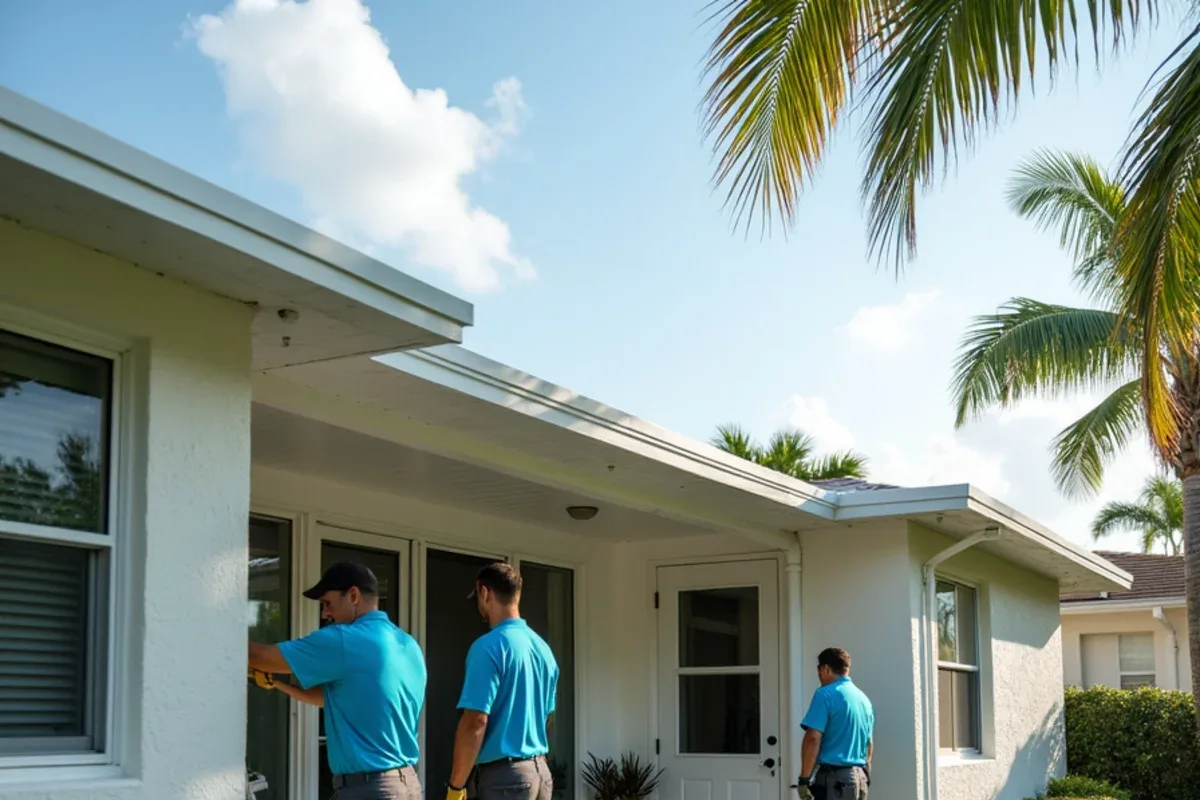
Gutters only help if the downspouts deliver water somewhere useful. Block homes sit on slabs close to grade, so water released at the corner can run straight back under the wall. We aim downspouts toward the lawn, the swale or a drainage area, with extensions or splash blocks that carry water several feet out.
Side yards between older houses are often tight, with an AC pad, a fence and a neighbor's wall a few feet away. In those spots we pipe water toward the front or back of the lot rather than dumping it into the narrow strip. Underground drainage is an option where the yard allows, but it is not always necessary on a modest ranch.
What mid-century block houses teach us on install day
Hurricane shutter hardware is the first thing we plan around. Accordion tracks, storm-panel headers and roll-down boxes are often mounted just under the eave on these houses, right where a gutter outlet or a downspout elbow wants to go. We lay out outlets so each downspout clears the tracks and the panels still close, because a gutter that blocks a shutter is a problem you only discover with a storm on the way.
Downspout straps on a block wall go in with masonry anchors, not wood screws, and each hole gets sealed so water cannot track into the stucco. Many of these roofs have also been replaced two or three times, and every roofer left the edge a little different: shingles hanging well past the fascia on one side, short of it on another, and wood painted so many times that the rot underneath is hidden. A screwdriver probe at every hanger location finds it before the gutter does.
White, chalky deposits on the lower stucco, called efflorescence, show up where a wall stays wet at the base. Block and stucco are porous, so they draw in splash water and push dissolved minerals to the surface as they dry. Those white bands are a useful map of where roof water has been landing for years, and where the first gutter runs should go.
Trade-offs we talk through with owners
- Partial gutters are a real option. Covering only the entry, the patio and the tight side yard solves most problems on many ranches, though the open sides still drip at the wall.
- Gutters add a chore. Under black olive or mahogany trees they need regular cleaning, while a roof edge with no gutter has nothing to clog.
- Fascia work can grow the scope. On a house this age, the board behind the gutter sometimes needs more carpentry than the gutter itself, and a good quote says so up front.
If you are still deciding whether your house needs gutters at all, our guide on whether you need gutters in South Florida walks through that question side by side.
Choosing gutters for a ranch home in Florida
Mid-century houses look best with a gutter that disappears into the trim. Painted seamless aluminum gutters in white or a color matched to the fascia keep the long, low roofline clean, and 5-inch K-style is often enough on these modest roof faces, with 6-inch where a large rear roof drains to one side.
Some of these homes already have gutters added in the 1970s or 1980s: thin sectional pieces, galvanized steel, or a mix of both. If those are leaking at the joints or rusting through, a full gutter replacement with seamless aluminum and new fascia where needed is usually cleaner than piecemeal fixes.
We work on block homes throughout Fort Lauderdale and Hollywood, and on the dense postwar streets of Hialeah. Installations carry a 3-year workmanship and 20-year materials warranty.
Giving an older block house the drainage it never had
Mid-century CBS homes were built to shrug off the rain, and the walls mostly do. The stained stucco, mildew, washed-out beds and wet patios are the cost of letting every drop fall at the base of the wall. Gutters on the right sides, a sound fascia and downspouts that carry water out of tight side yards fix most of it.
If your block home has never had gutters, or still wears thin sectional pieces from decades ago, call Southern Gutters FL for a free estimate. We will walk every side, check the fascia and shutter hardware, and write a plan that covers only what the house actually needs.
Questions about gutters for cbs homes
Do CBS homes really need gutters if the walls are concrete?
The walls will not rot, but the problems show up elsewhere: stained stucco, splash-back mildew, eroded landscaping, water at doors and pooling along the slab. On many homes, gutters on just the sides that cause trouble solve most of it without wrapping the whole house.
Can gutters be added to a house with exposed rafter tails?
Yes, with some planning. Either a continuous fascia board is added across the rafter ends to give the gutter a solid mount, or a strap-style hanger fastens to the roof deck. We look at the roof edge and the style of the house before recommending one.
Do I need gutters on every side of a CBS house?
Not always. On many mid-century ranches the trouble concentrates over the front entry, the rear patio, the Florida room and any narrow side yard, and gutters on those runs solve most of it. Sides where water falls onto open lawn that slopes away can often stay as they are. A walk around the house during an afternoon storm shows which edges need attention.
Will gutters stop the stains on my stucco?
They stop new stains from forming by catching the water that splashes soil and runoff onto the lower wall. Existing stains, mildew and white mineral deposits stay until the stucco is cleaned, and a soft wash after the gutters go up usually brings the wall back. Downspouts need to discharge away from the wall, or the splash simply moves to the corner.
Services mentioned in this guide
Seamless Gutter Installation
Aluminum gutters roll-formed on site to each wall’s length, hung on stainless hardware, with a 3-year/20-year warranty.
Learn moreGutter Replacement
Rusted, leaking or undersized gutters swapped for seamless aluminum, with old runs hauled off and fascia checked first.
Learn moreServing Fort Lauderdale, Hollywood and the rest of South Florida.