

By Chance, owner of Southern Gutters FL · Published · Last updated
Key takeaways
- A buried line only drains if its outlet sits lower than its inlet, and on flat South Florida lots that fall is precious.
- Dry wells and gravel pits often fill with groundwater during the rainy season and stop accepting roof water.
- Solid-wall pipe, a short run and an outlet that daylights at a swale or low lawn edge beat deep, perforated designs here.
- Most underground drain clogs start with sand, granules and leaf fragments that settle where the pipe runs too flat.
- A cleanout near the downspout makes flushing a five-minute job instead of a dig.
Underground downspouts work in Florida only when the buried line keeps falling all the way to an outlet that stays above the summer groundwater. Use short, shallow runs of solid pipe, end them at a swale or low lawn edge, add a cleanout near the downspout, and skip dry wells where the water table rises after weeks of storms.
Most advice about underground downspouts was written for places where the ground soaks up water like a sponge and the water table sits far below the lawn. Florida is not that place. Across much of Broward and Miami-Dade, groundwater can rise to within a few feet of the surface by late summer, and the sand often gives way to limestone not far below.
That changes how a buried line has to be designed. A system that would work fine in Atlanta can sit half full of groundwater in a Davie backyard, then gurgle, back up and spill at the downspout every afternoon cloudburst. Here is why that happens, the design rules our crew follows, and the honest cases where burying the line is the wrong call.
Why high water table drainage behaves differently
Water moves through a buried pipe only by gravity. The roof water enters at the downspout, rides down a gentle slope and leaves at the far end. If that far end is underwater, or sits at the same level as the inlet, the pipe simply fills and stops.
In South Florida the lowest available point is often only a few inches below where you started. Lots are graded nearly flat, and in May through October the water table climbs after weeks of daily storms. A soakaway pit dug three feet down in March can be a pond by August. That is the single biggest reason we see buried downspout problems on otherwise well-built systems.
Limestone adds a second wrinkle. In parts of Miami-Dade the rock sits so close to the surface that trenching hits it quickly, which pushes installers to run lines shallower and flatter than they should.
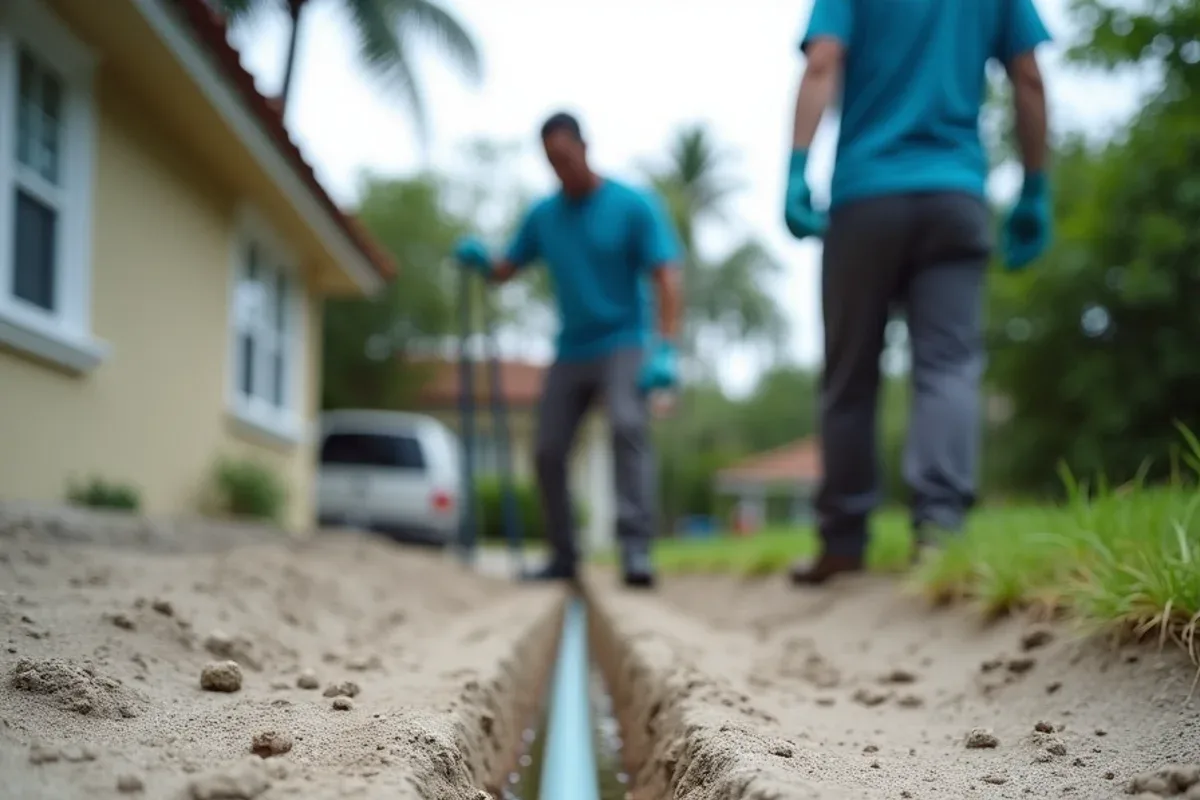
Buried downspout problems: how to tell your line is struggling
A failing underground line rarely announces itself in dry weather. Watch it during a real downpour instead:
- Water bubbles out around the joint where the downspout meets the buried adapter.
- The gutter above that corner overflows even though the trough is clean.
- The pop-up emitter never lifts, or lifts only long after the rain stops.
- A soggy strip or sinkhole forms along the path of the pipe.
- You hear gurgling at the downspout, a sign air is fighting standing water in the line.
Any one of these can mean a clog, a crushed section or a line that has lost its fall to settling. Two or more together usually point to a design that never had enough slope to begin with.
Six rules for underground downspouts in Florida yards
These are the principles we work from when we plan underground downspout drainage on a Broward or Palm Beach lot.
1. Find the outlet first, then work backward
We locate the lowest practical discharge point, usually the front swale, a lawn edge that falls toward the street or a side-yard low spot, and only then decide where the trench starts. If no outlet is meaningfully lower than the downspout, we say so before anyone digs.
2. Keep it shallow
Deeper is not better here. Every inch of depth at the start costs an inch of fall at the end. A line that begins just below the sod gives the water somewhere to go.
3. Use solid-wall pipe for the carry
Perforated pipe lets groundwater in as easily as it lets roof water out. Smooth solid pipe carries water to the outlet without filling up from below or pulling in sand.
4. Keep runs short and direct
Each extra foot needs more fall, and every bend is a place for debris to settle. We would rather run two short lines to two outlets than one long line that snakes around a pool deck.
5. Add a cleanout
A capped cleanout fitting just past the downspout lets a hose or flushing tool reach the pipe without pulling the downspout off the wall.
6. Filter at the top
Gutter guards or a downspout strainer stop leaves and seed pods before they ever enter the buried section. On a tree-heavy lot this matters more than any other rule.
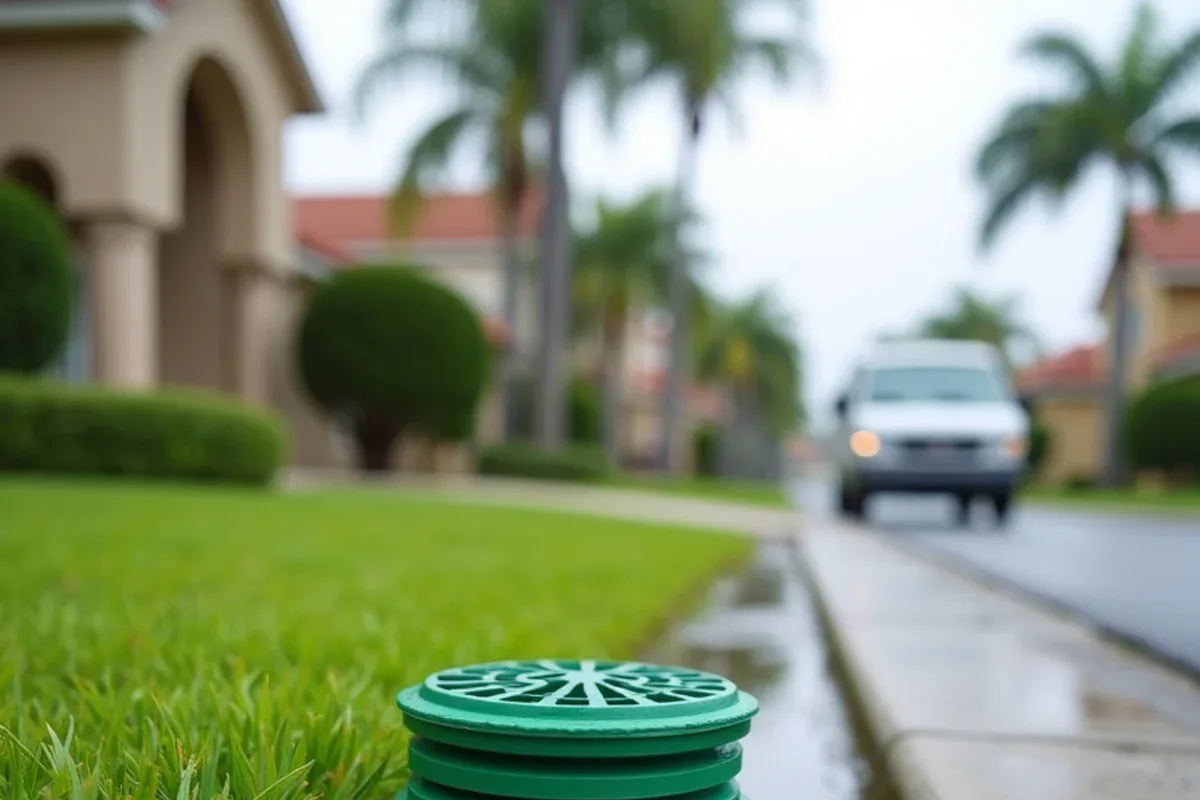
Pop up emitter, swale outlet or dry well?
The end of the pipe decides whether the system works. Here is how the common choices hold up on a high water table.
| Outlet | How it works | Rainy-season reliability | Watch for |
|---|---|---|---|
| Pop-up emitter | Lid lifts under water pressure and spills onto the lawn | Good if set lower than the inlet | Grass overgrowth, mower damage, lid stuck shut with sand |
| Open daylight to swale | Pipe ends at a grate or open end at the swale edge | Best on most lots | Local rules on swale work; keep the end clear of clippings |
| Daylight at lawn edge | Pipe exits at a low spot inside the property | Good when grade allows | Erosion where the water exits; add rock if needed |
| Dry well or gravel pit | Water soaks into a buried chamber | Poor once groundwater rises | Fills and holds water for weeks in summer |
| Tie-in to storm system | Connection to a drain inlet | Varies | Usually needs permission; rarely allowed for homeowners |
A downspout to swale connection is often the cleanest answer because the swale is already the low point the neighborhood was graded toward. Cities manage swales as part of their stormwater design, so check local rules before trenching into one, and never route a line so it discharges onto a neighbor's lot.
Clearing an underground drain clog without digging
Most clogs we pull from buried lines are a slurry of sand, roof granules, black olive leaf fragments and the odd seed pod, packed into a low spot or the first elbow. A few approaches, in order:
- Pop the emitter lid or open the outlet and clear whatever is sitting at the exit.
- Run a garden hose into the cleanout and watch the outlet; steady flow means the line is mostly open.
- If water backs up, feed a flexible drain snake or jetter from the outlet end, pushing the clog back toward the larger opening.
- Flush again and confirm clear water at the outlet before reattaching the downspout.
If the line clogs again within a season, the fall is probably too flat, or a section has sagged. That is a re-grade, not a cleaning problem.
If you would rather not snake the line yourself, our downspout cleaning and flushing visit clears the gutter outlet, the elbows and the buried run in one trip, and it ends with a hose test that has to show water leaving the emitter.

When we recommend not burying the downspout
Some lots just do not have the grade. A home in western Broward with a backyard that sits level with a canal bank and a front yard that slopes toward the house is a poor candidate for a buried run. On properties like that around Davie and Miramar, an above-ground extension, a splash block and a regraded bed often move water farther from the slab than a pipe ever would.
We will tell you that on the estimate. A buried line that holds standing water all summer is worse than no line at all, because it hides the problem and breeds mosquitoes at the emitter.
What our crew finds when a buried line stops draining
When we open up a line that has quit, the cause is rarely exotic. The most common find is a run laid with almost no fall, often with a belly where the trench backfill settled after the job. Sand and roof grit collect in that dip, leaf fragments snag on the sand, and within a season or two the pipe is half full of wet slurry.
The second pattern is thin corrugated or perforated pipe chosen because it bends easily around beds. Every ridge in a corrugated wall holds grit, and the holes let the surrounding sand wash in once groundwater comes up. We usually replace those runs rather than flush them year after year.
Pop-up emitters bring their own quirk. Many have a small weep hole meant to let leftover water drain after a storm, and fine sand plugs it quickly. Once that happens the pipe sits full between rains, which is exactly the standing water mosquitoes look for.
Before you approve a buried run, ask for these in writing
- Where the outlet will be and how much lower it sits than the downspout.
- The pipe type for the carrying run (solid smooth-wall, not perforated).
- Where the cleanout goes and how the line will be flushed later.
- What happens to the sod, pavers or mulch along the trench.
- Whether a swale outlet needs approval from the city first.
The honest trade-off: a good buried line is invisible and keeps water off the walkway, but it needs a flush every year or two and clean gutters upstream. If nobody will look after it, a visible extension that you can watch failing is often the better system.
Buried downspouts on wet lots: the short version
On a South Florida lot the outlet and the fall decide everything. Keep the line shallow, solid and short, give it a cleanout, and send it to a swale or lawn edge that still sits lower than the downspout in September. Where that grade does not exist, an above-ground extension is the honest answer.
Southern Gutters FL plans and flushes these systems from our North Lauderdale shop across Broward, Palm Beach and Miami-Dade. Call (855) 633-0442 for a free estimate, and we will measure the drop to your outlet before anyone picks up a shovel.
Questions about underground downspouts florida
How deep should an underground downspout be in Florida?
Usually as shallow as practical, often just below the sod and topsoil. On flat lots with a high water table, burying the pipe deeper uses up the fall you need at the outlet. The goal is a continuous downhill slope from downspout to discharge, not depth for its own sake.
Can I use perforated pipe for buried downspouts?
We generally avoid it for the carrying run on South Florida lots. When groundwater rises, perforated pipe takes on water and sand from the surrounding soil, which fills the line and speeds up clogging. Solid smooth-wall pipe keeps roof water moving to the outlet.
Why does my pop-up emitter stay closed during heavy rain?
Either the line is clogged, the emitter sits higher than the downspout inlet, or groundwater has filled the pipe so there is no pressure to lift the lid. Clear the emitter, flush from the top, and if it still stays shut, the line likely needs a lower outlet.
What slope does a buried downspout line need?
Common guidance is at least about 1/8 inch of fall per foot of pipe, roughly a 1 percent grade, and more is better. On a 40-foot run that adds up to about 5 inches of drop between the downspout and the outlet. On flat South Florida lots we measure that drop before trenching, and if the outlet cannot sit that much lower, we recommend an above-ground option instead.
Services mentioned in this guide
Underground Downspout Drainage
Downspouts piped underground to pop-up emitters or the swale, pitched to work with a high water table.
Learn moreDownspout Cleaning & Flushing
Clogged downspouts flushed, snaked and flow-tested, including buried lines and frog-packed elbows.
Learn moreServing Davie, Miramar and the rest of South Florida.